
reading korea
literature in hell joseon

To get a bit closer to the country, I read some Korean books whilst I was working over there. As I’m still trying to decompress from whatever the last four weeks were (the highs, the lows, the day when I almost went on stage in a wig and a dress in place of an injured actor), I’m gonna walk you through the books I read.
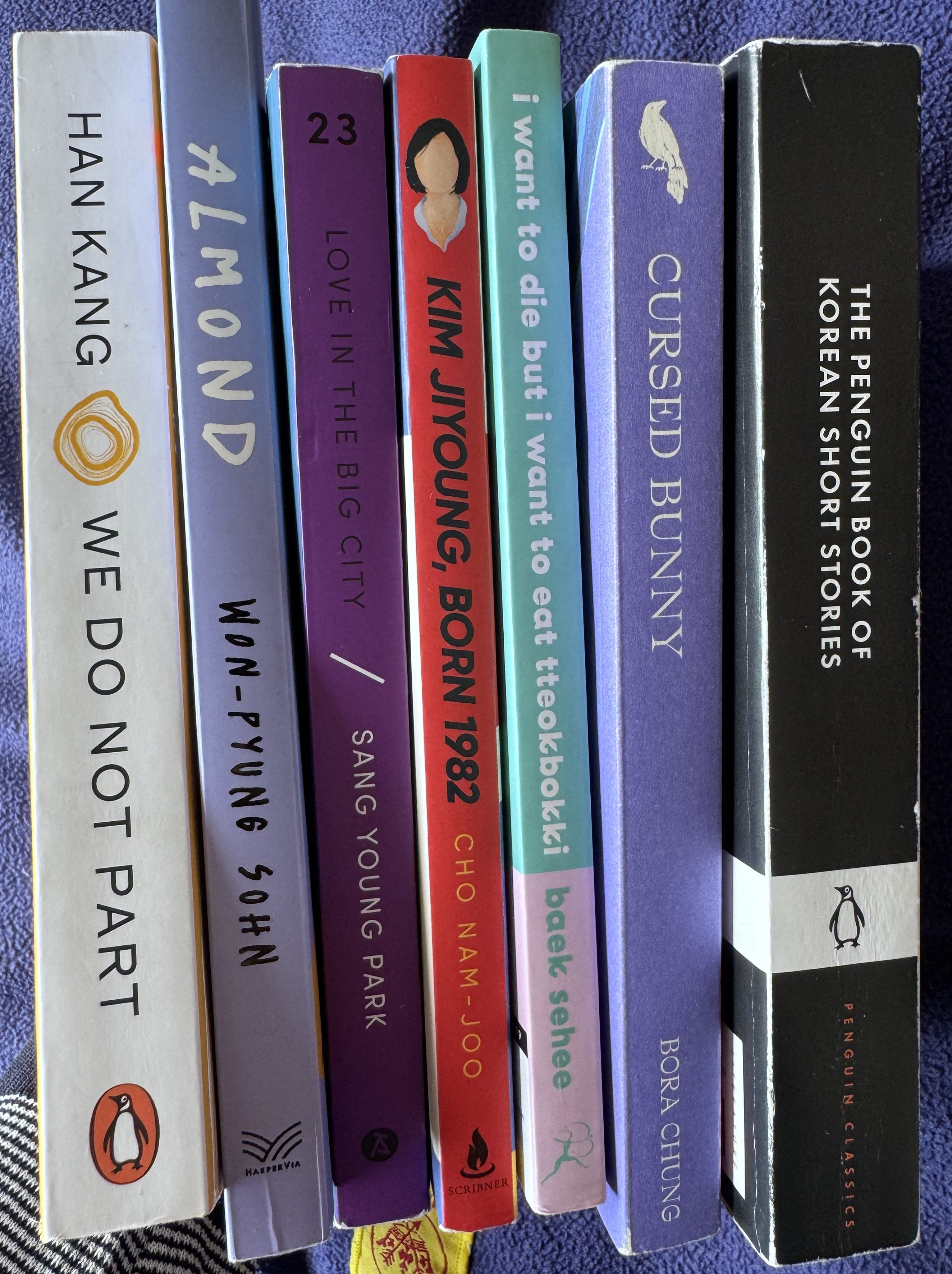
The Penguin Book of Korean Short Stories was gifted to me by Tara. What a great covering of Korean history, culture and voices on a whole range of topics. I’d say overall these stories are quite bleak in tone, especially those that engage with the Korean War and its aftermath. The earliest stories from the 1930s were oddly quiet and pastoral, as if trying to ignore the weight of Japanese occupation, though the pathetic Korean characters and their doleful musings make it clear there’s a wider allegory at play.
I liked many of the stories, including Kim Chunghyok’s The Glass Shield and Chu Yosop’s Mama and the Boarder but my favourite was The Last of Hanak’o by Ch’oe Yun, where a group of a man tries to catch up with a mysterious woman on a business trip in Venice, and tells the story of what his obsessive group of friends may or may not have done to Hanak’o years ago. It’s crisp and taut and terrifying: a masterclass.
The stories in the collection are split into sections (Tradition, War etc.) and I was particularly interested in a section titled “Hell Choson”. Korean literature scholar Kwon Youngmin describes this in his introduction as a term reflecting “the discontent of a generation of young people who have dutifully obtained a university education only to find a paucity of jobs commensurate with their education. More generally the term reflects the disappointment with a lifestyle marked by economic inequality, crony capitalism, excessive work hours and inadequate salary, and the societal manifestations of this malaise, such as the highest suicide rare among the OECD nations, a negative birth rate and a divorce rate that hovers around 30 per cent.” Can you see why the stories were quite bleak!
Another set of short stories I read was the much touted Cursed Bunny by Bora Chung. These sci fi horror delights are so brutal, weird and twisted. I laughed as much as I recoiled at the stupid, bizarre tales: a woman finds a talking head made of faeces in her toilet, or another where a man feeds his daughter to his son in order to extract gold from his body.
Each story is saying something about this “hell Joseon” Youngmin describes, dissecting a less desirable aspect of Korean society and mushing it back together in the strangest way possible. Fair play to Bora Chung, the stories in Cursed Bunny are dynamic and memorable, even if they mostly made me wince in repulsion.
Each of the novels I picked also seemed to cover a particular social strand, so it felt obvious to look at them through those lenses. This wasn’t planned, but did help me in my quest to understand Korea a bit better.
The growing plight of adult mental health is addressed through conversations with a therapist in the brilliantly titled I Want To Die But I Want To Eat Tteokbokki by Baek Sehee. I didn’t quite want to die at any point in Korea (perhaps when I left my passport on the plane, to be fair) but I always want to eat tteokbokki, this squishy rice cake dish in a spicy sauce.
Unfortunately I didn’t really enjoy this book. The therapy feels very surface level, the narrator a bit annoying, and the whole thing never really goes anywhere substantial. Mostly it’s just sad to read, knowing that despite the success the book brought her (as a worldwide must-read in 2022), the writer died in 2025. Whilst the family did not want to state the cause of death, it’s fairly easy to read between the lines and sad to think she wasn’t ultimately able to heed the advice she gave to so many others.
Kim Jiyoung, Born 1982 is a similarly viral book that blends fact and fiction, deeply concerned with the inequalities faced by women in South Korean society. Korea has one of the widest gender pay gaps and traditional patriarchal notions of a woman’s place in the world are often still upheld. Author Cho Nam-Joo investigates this by creating a character, the titular Kim Jiyoung, as an everywoman, narrating her life from birth to mid-life crisis with all its unfair expectations and injustices.
Whilst this was a bit more informative than Baek Sehee’s therapy memoir, I still felt put off by the surface level messaging which stood to undermine the fictive world of the story. That is until the final chapter, told from the perspective of a male medical professional assessing Kim Jiyoung’s life, which brilliantly spun the novel on its head and redeemed the more obvious passages that had preceded it.
LGBT rights in South Korea are a mixed bag. Whilst sexual acts are legal, they are illegal for men serving in the military. As the country has a two year mandatory conscription to the military, this means all gay men are subject to the illegality of their sexuality. Same sex marriage is not legal and not considered a hot issue topic like it is in the west. A survey in 2019 showed that 75% of Koreans think they do not know a gay person and 60% would not feel comfortable making friends with one.
Given this, it was super interesting to read Love in the Big City by Sang Young Park, exploring the life and loves of a gay man living with HIV in Seoul as he frequents the capital’s queer clubbing district Itaewon and initiates a series of relationships and encounters with a variety of men. The title feels a direct reference to Armistead Maupin’s work, and there’s a parallel to draw, but I felt also the cool breeze running through the interconnected stories of Sang Young Park’s work was reminiscent of a Wong Kar Wai film: lustful and neon-drenched, soul searching but never earnest, its pretensions always light touch.
The young adult novel Almond also felt like a movie, a really fucked up coming-of-age film. In other hands, the central conceit of a character who cannot feel emotions would feel overly trite and get boring quickly, but Wong-Pyung Sohn strikes a balance in brilliantly controlled prose, as Protagonist Yunjae meets a troubled teenager called Gon, and the two make for a dangerous pair. I’d recommend this to fans of Kawakami’s Heaven.
The only Korean writer I’d read anything by in advance of going there was, of course, the inimitable literature legend Han Kang, recent winner of the Nobel Prize for Literature. Of her work I’d read The Vegetarian, her breakout novel, and studied a short story of hers on my MA. I picked up her latest translated work, We Do Not Part, and found myself thrown into its ominous clutches: half snowstorm, half dreamy meditation on the real life horrors of the 1948 Jeju uprising.
It’s the best of the lot; it’s evident why she’s an international prize winner. The soft texture of the prose unveiling the deep trauma layer by layer, revelations and memories resurfacing throughout the story, which ostensibly follows Kyungha as she goes to her friend Inseon’s home on the island to feed her birds for her whilst she’s in hospital. The journey takes her into the heart of Inseon’s family trauma, but it doesn’t offer her any way out. There’s no answers in We Do Not Part; the novel is more like a lyrical, meandering poem that ruminates and prods but never fully unravels.
If you read anything from this list, make it Han Kang. And I’d generally recommend reading books from a country you’re going to. It has made me think about South Korea so much more than I would as just a tourist, simply navigating translation apps and metro maps. It’s been a great extension of my travels to a beautiful, brilliant country with some deep seated social issues, all of which are being hashed out and exposed by its talented writers.
Ooh my partner adores weird sci-fi horror, I'll have to grab that for them👀